Biography
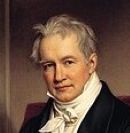
Alexander von Humboldt was a German naturalist, geographer, explorer and one of the most influential scientists of the nineteenth century. He was among the first thinkers to describe nature as an interconnected whole in which climate, plants, animals, geology and human activity continually influence one another.
He was born in Berlin on 14 September 1769 into a wealthy Prussian family. His father, Alexander Georg von Humboldt, was a former army officer and court chamberlain, while his elder brother Wilhelm von Humboldt later became an important linguist, philosopher and educational reformer. From an early age Alexander developed a fascination with plants, rocks, maps and accounts of voyages to distant parts of the world.
Humboldt studied at several institutions, including the University of Göttingen, and later attended the Freiberg School of Mines, where he trained in geology and mineralogy. He entered the Prussian mining service and quickly gained a reputation for energy and scientific ability. His deepest ambition, however, was to travel beyond Europe and study nature on a vast geographical scale.
In 1799 he set out with the French botanist Aimé Bonpland on one of the great scientific expeditions of the age. During the next five years they travelled through regions of present-day Venezuela, Colombia, Ecuador, Peru, Cuba and Mexico. They explored the Orinoco River, investigated its connection with the Amazon river system through the Casiquiare, and collected thousands of botanical and natural specimens. Humboldt carried an impressive collection of scientific instruments and constantly recorded temperature, atmospheric pressure, altitude, magnetic phenomena and other physical measurements.
In 1802 Humboldt attempted to climb Chimborazo in the Andes, then widely regarded as one of the highest mountains in the world. Although he did not reach the summit, he climbed to an extraordinary altitude for his time. His observations of how vegetation changed with elevation helped him develop a new understanding of the geographical distribution of plants and its relationship to climate. This work became foundational to the development of plant geography and biogeography.
Humboldt was interested not merely in collecting facts but in discovering relationships between them. He observed, for example, how deforestation could affect water supplies and local climate, and warned that human activity was capable of altering the natural environment. He also studied the social and economic conditions of the Spanish colonies and was an outspoken critic of slavery and colonial exploitation.
After returning to Europe in 1804, Humboldt spent many years in Paris, where he analysed the enormous body of information gathered during his travels and worked with leading scientists of the period. He published extensively on geography, geology, botany and exploration. Among his most important works were Views of Nature, Personal Narrative of Travels to the Equinoctial Regions of America and Political Essay on the Kingdom of New Spain.
In 1829, when he was nearly sixty years old, Humboldt undertook another major scientific journey, this time through the Russian Empire. He travelled across the Urals and into parts of Siberia and Central Asia, continuing his measurements and comparative study of the Earth.
The great project of his final decades was Cosmos, an ambitious attempt to describe the physical universe as a unified whole. The first volume appeared in 1845. In this work Humboldt brought together astronomy, geology, geography, biology and the history of scientific thought, seeking to reveal the underlying unity of nature behind its immense variety of forms.
Alexander von Humboldt died in Berlin on 6 May 1859 at the age of eighty-nine. He continued working on Cosmos until the final years of his life.