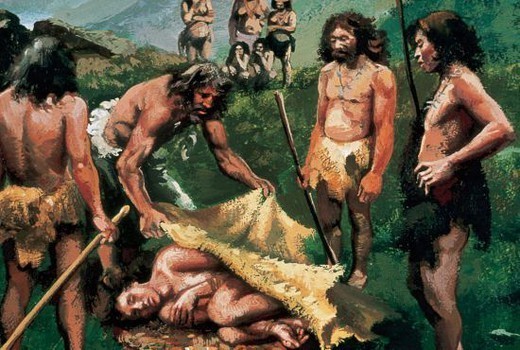
Homo sapiens began to be formed in Africa, about 300,000 years ago, from Homo erectus gene pool, with the prevalence of genetic changes that influenced the way of thinking and acting. Fossils of about 150,000 years old show the same brain size as today (1,350-1,400 cubic centimeters). His behavior began to resemble the present’s humans as they spoke, processed the raw materials, made technological inventions, displayed symbolism skills. As evidenced by studies of the size and shape of the earstones, which convert sounds into sound signals to the brain, it has developed oral speech. The frequencies of our normal speech are 2-4 KHz, similar to those of homo Sapiens. Possibly homo erectus was uttering words, but homo Sapiens created a real -even primitive- language. His great achievement was the creation of art (cave paintings, figurines of women, primitive musical instruments). The life of homo Sapiens was organized in groups of around 20 to 50 people with males to hunt and females taking care of babies and picking fruits and vegetables. In the evening, depending on the success of hunting, they were eating turtles, rabbits, deer, pigs or even elephants, rhinoceroses, gorillas. If the hunt had no success, they were eating herbs and fruits. In addition for the meat, they used animals for their skin as clothing, horns and bones for the manufacture of tools and weapons. He further perfected the construction of tools, adding fishing gear (bait, net, harpoon-tridles). He lived in caves when was cold or in sleek huts in warmer areas, always temporary. He was the first kind of man who buried the dead and in a sideway pasiton with bent knees. They probably believed in the existence of a post-mortem life, so they had a religious conscience.
Fossils such as the Petralonian man in Greece, the man of Aragonese in France, and others in Germany, Zambia and elsewhere, have been found which have many differences but share two common points: they were more sophisticated than Homo erectus ( larger brain) and more primitive (thick skull and sturdy body) from Homo sapiens. So, there were another types of people who have not been adequately recognized. Back to the Story of Humankind