Earth’s primordial atmosphere was rich in hydrogen, nitrogen, carbon dioxide, water vapor, and sulfur compounds, while free oxygen was almost completely absent. Intense ultraviolet radiation, constant lightning, and heat from widespread volcanic activity created conditions favorable for complex chemical reactions. Since a protective ozone layer did not yet exist, the first organic molecules gradually formed, including amino acids and other compounds essential for life. In 1952, Stanley Miller experimentally demonstrated that organic compounds could form under conditions simulating Earth’s primordial atmosphere, largely confirming the theoretical ideas proposed by Alexander Oparin and J. B. S. Haldane.
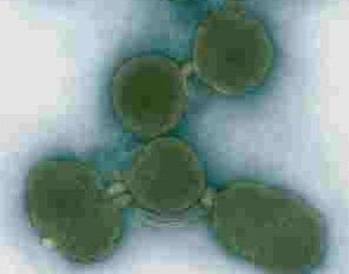 The first forms of pre-biological organization probably appeared on mineral or crystalline surfaces within warm aquatic environments. There, chemical elements were close enough to interact continuously, gradually forming increasingly complex compounds. Some of these molecules acquired the ability to self-replicate, leading to the first primitive genetic systems.
Fatty compounds formed microscopic membranes, creating primitive structures resembling cells. Within these membranes, complex chemical processes evolved, and the first single-celled organisms appeared.
The first forms of pre-biological organization probably appeared on mineral or crystalline surfaces within warm aquatic environments. There, chemical elements were close enough to interact continuously, gradually forming increasingly complex compounds. Some of these molecules acquired the ability to self-replicate, leading to the first primitive genetic systems.
Fatty compounds formed microscopic membranes, creating primitive structures resembling cells. Within these membranes, complex chemical processes evolved, and the first single-celled organisms appeared.
The earliest organisms were prokaryotic — cells without a nucleus, similar to modern bacteria. They reproduced asexually through simple cell division and evolved slowly over enormous periods of time. Later, eukaryotic organisms appeared: cells with an organized nucleus and a more complex internal structure. The development of sexual reproduction greatly increased genetic diversity, allowing faster evolution and the emergence of new forms of life. Back to the Story of Humankind