Alongside the first worm-like forms of life, biological evolution and natural selection led to the appearance of sponges, mollusks, arthropods, and various types of algae in the ancient oceans. Organisms gradually became more complex: cells began to specialize and form distinct tissues and organs. As a result, primitive marine animals developed gills, fins, mouths, eyes, and tails. During periods of glaciation, competition for food and survival intensified. Many animals developed calcareous shells and hard exoskeletons to protect themselves from predators. Among the dominant organisms of that era, about 530 million years ago, were the Trilobite trilobites. Trilobites were marine arthropods usually measuring between 3 and 10 centimeters in length, although some species reached much larger sizes. They possessed a hard exoskeleton and could curl up their bodies for defense, much like certain arthropods do today. A few tens of millions of years later, the first vertebrates appeared: primitive fish with internal skeletons, but without jaws and without well-developed fins.

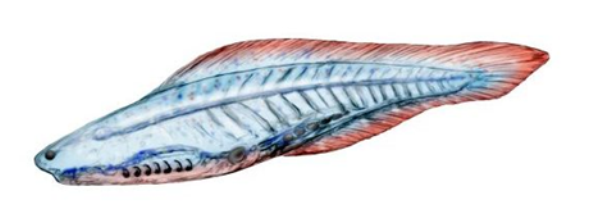
500 MILLION YEARS AGO Various crustaceans and the first fish-like vertebrates appeared. At the same time, the first coral reefs formed, while major geological movements pushed the southern continents toward the poles. Earth experienced cold periods and extensive glaciations. Some fish gradually began using their fins not only for swimming, but also for supporting and lifting their bodies along the bottom — an evolutionary development that would later lead to the appearance of the first tetrapods.
450 MILLION YEARS AGO Placoderms appeared — primitive jawed fish. Their heads and the front part of their bodies were protected by hard articulated bony plates, which functioned as natural armor.
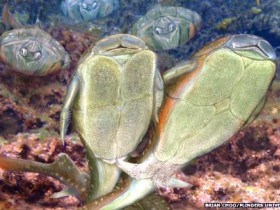 Before this evolutionary development, the reproduction of most fish occurred externally, through the release of eggs and sperm into the water. After the extinction of the placoderms about 360 million years ago, external fertilization remained dominant for a long period. Later, however, the first sharks and rays evolved internal fertilization again, along with more advanced reproductive behaviors.
Back to the Story of Humankind
Before this evolutionary development, the reproduction of most fish occurred externally, through the release of eggs and sperm into the water. After the extinction of the placoderms about 360 million years ago, external fertilization remained dominant for a long period. Later, however, the first sharks and rays evolved internal fertilization again, along with more advanced reproductive behaviors.
Back to the Story of Humankind