Biography
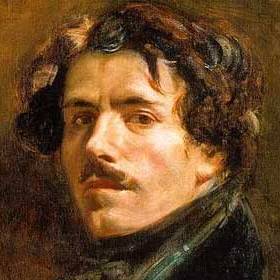
Eugène Delacroix was an important French painter of the 19th century, one of the last great painters of the Renaissance tradition and one of the first artists of the modern era. He was born on April 26, 1798, in Saint-Maurice, near Paris. His father was a politician who had played an active role in the French Revolution and during the period of the Directory.
During his childhood, Delacroix experienced several accidents. On one occasion, he nearly drowned because of the negligence of his nanny, while on another he almost died in a fire. His father died in 1805 and his mother in 1814. Delacroix had sufficient financial means to receive a good education, and in 1815 he began studying painting in the studio of the academic painter Pierre-Narcisse Guérin. The following year, he also enrolled at the École des Beaux-Arts, but he was dissatisfied with the school and did not complete his studies.
He eventually established his own studio, and in 1822 he presented his first major work, *Dante and Virgil in Hell*. His teacher strongly criticized the painting, while some critics praised it enthusiastically. In 1824, inspired by the Greek War of Independence and by a real-life event, he presented *The Massacre at Chios*. The following year he travelled to England, where he was influenced by British painters. From 1827 onward, he created a series of paintings inspired by the Greek War of Independence, having become a passionate philhellene, influenced in part by Lord Byron.
During this period, his fortune had been exhausted and he was facing serious financial difficulties. In one letter he wrote, “I have no idea how I shall find food tomorrow.” Despite his poverty, he refused to accept commissions or artistic instructions that might compromise his independence. As he wrote in another letter, “I shall remain on my own path even if the earth and the stars are on the other side.” The official responsible for purchasing works of art for the French state told him, after he submitted *The Death of Sardanapalus* to an exhibition: “If you mean to say that this is painting, then you will have to wait a long time before receiving a commission from me.”
The year 1830 was decisive for Delacroix. He took part in the revolution that drove the Bourbons from power, thereby gaining the favor of King Louis-Philippe. The following year he painted *Liberty Leading the People*, a work that brought him fame and financial success.
In 1832, Louis-Philippe sent him on a diplomatic mission to Morocco. Delacroix was deeply impressed by the colors, landscapes, and people of North Africa. After his return, he produced numerous paintings inspired by life in Morocco and the wider region.
In 1833, one of his friends became a minister, and Delacroix began receiving numerous government commissions, both for paintings and for large-scale murals in public buildings and churches. From then on, he became a dominant figure in French artistic life. In 1857, he was elected a member of the French Institute.
Delacroix died in 1863, having achieved recognition during his lifetime as one of the most important and influential painters of his era.