Bipedal walking was one of the most important steps in human evolution. When the ancestors of humans began to walk on two legs, their hands were freed from the task of movement and gained new possibilities. They could now carry food, hold objects, use stones and sticks, and communicate through gestures and hand movements. The constant use of the hands gradually led to greater dexterity, improved nervous coordination, and the development of fine motor skills. Through this long evolutionary process, the first tools and weapons appeared, greatly increasing the chances of survival for early humans.
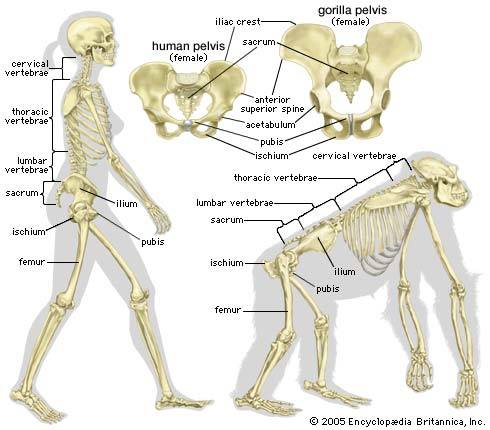 The upright posture also profoundly affected human anatomy. The spine, pelvis, and muscles adapted to bipedal walking, while the evolution of the brain and vocal system later contributed to the development of more complex communication and eventually speech.
However, this transition also had consequences. The human skeleton had originally evolved for a different mode of movement, and upright posture placed greater strain on the lower back, neck, and feet. Many modern problems, such as back pain and spinal disorders, are related to this evolutionary adaptation.
The greatest evolutionary challenge involved childbirth. As the human brain increased in size, babies were born with increasingly larger heads, while the pelvis still needed to remain suitable for upright walking. As a result, human infants are born relatively immature and remain dependent on adult care for a long period of time. Unlike many other animals, human babies cannot walk or survive on their own shortly after birth. This prolonged period of dependence likely contributed to the development of strong social bonds, cooperation, and solidarity within early human groups. Collective childcare and cooperation for food and protection became major advantages for the survival of the human species. Back to the Story of Humankind