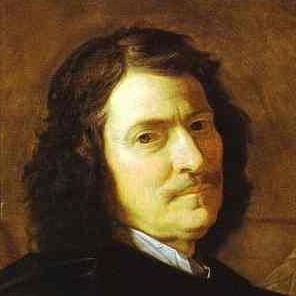
Nicolas Poussin (1594–1665) was the greatest French painter of the seventeenth century and one of the founders of European Classicism. He was born in June 1594 in the village of Les Andelys, Normandy, France. From an early age he showed a strong interest in drawing and painting, studying the works of Renaissance masters and ancient art. After several unsuccessful attempts, he finally traveled to Rome in 1624, a city that would become his permanent home and the main source of inspiration for his artistic development.
In Rome, Poussin immersed himself in the study of classical antiquity, ancient sculpture, mythology, history, and the works of Raphael and other Italian Renaissance masters. Unlike many Baroque painters of his time, who emphasized dramatic movement and emotional intensity, Poussin sought balance, harmony, clarity, and intellectual order. His paintings were carefully planned and often depicted scenes from classical mythology, ancient history, the Bible, and literature.
Among his most celebrated works are Et in Arcadia Ego, The Rape of the Sabine Women, The Inspiration of the Poet, and the series The Four Seasons. Through these works he developed a highly disciplined style in which every figure, gesture, and compositional element served a clear narrative and philosophical purpose.
In 1640 Poussin was invited to Paris by King Louis XIII and Cardinal Richelieu, but court life proved frustrating and he soon returned to Rome, where he spent the remainder of his life. Over the years his art became increasingly reflective, emphasizing moral themes and the enduring relationship between humanity and nature.
Nicolas Poussin died in Rome on November 19, 1665.