Biography
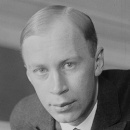
Sergei Prokofiev was a significant Russian composer and pianist, born on April 23, 1891, in Sontsovka, a small village in Ukraine. His father was an agronomist, while his mother was an educated woman with knowledge of music and piano, who became his first teacher. He displayed exceptional musical talent from a young age, composing a piece for the piano at the age of 5, and at 9, he wrote his own opera entitled "The Giant" after attending two operas with his mother in Moscow. He continued to compose, writing a symphony at 11 and becoming the youngest student at the Saint Petersburg Conservatory at 13 in 1904, where he completed his studies by winning the title of best pianist and receiving the Rubinstein Prize. He soon became known as a composer-pianist experimenting with ultra-modern forms, and his disagreements and conflicts with teachers at the time earned him the label "terrible child of music."
With the outbreak of the First World War, Prokofiev traveled to London, where he undertook many orders for operas and symphonies. After the Bolsheviks took power in 1918, he decided to leave the country, heading to the United States, where he wrote operas, ballets, symphonies, and piano concertos, and established a great reputation in America and Europe. However, many critics, especially when he first came to America, found his works "savage and mechanically played." In New York, he met his future wife, Lina Louvera, whom he married in 1923, and they lived for a few years in Paris, where he established himself as the "red composer of the avant-garde." From 1926, he began to consider and negotiate his return to Russia. He wrote, "I'm not interested in politics. I'm a composer first and foremost. Any government that lets me write my music in peace and publishes my compositions before the ink is dry is fine with me." In 1927, he made 21 appearances in Moscow, Leningrad, Kiev, and Odessa, and from 1933, he taught composition at the graduate school of the Moscow Conservatory. When he finally returned permanently to the Soviet Union, he was welcomed as a hero whose revolutionary music had conquered the West.
Prokofiev worked with the Stalinist government, gradually turning to folk, historical, and patriotic themes. In 1935-1936, he wrote the ballet "Romeo and Juliet," which is a top achievement of world art. At this time, he also began to show an interest in cinematographic subjects. During the German invasion in 1941, Stalin, by a sudden decree, fled with all civilized people, himself included, to the Caucasus for safety. Prokofiev's wife Lina was left in Moscow with their sons, while Sergei was sent to the Caucasus with a young poet, Mira Mendelssohn, with whom he had become romantically involved. He did not live with Lina again after this, but a final divorce was issued only in 1947, automatically, as a new law annulled all marriages of Soviets with foreigners. Sergei found himself free and married Mira. A month after his second marriage, his ex-wife was sentenced by the regime to forced labor and sent to Siberia, where she spent 8 years. She managed to survive and returned to Moscow in 1956. After many years of effort, she was allowed to leave the Soviet Union in 1972.
Prokofiev died on March 5th, 1953, which happened to be the same day as Stalin's death. Due to the crowded Red Square near his home, his body could not be exhumed for funeral proceedings until three days later. He was posthumously awarded the Lenin Prize in 1957, making him the first Soviet to receive this honor after his death, for his Seventh Symphony.