Biography
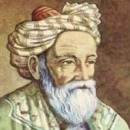
Omar Khayyam, born on May 18, 1048, in Nishapur, was one of the greatest intellectual figures of the medieval Persian world. A philosopher, mathematician, astronomer, and poet, he spent part of his childhood in Balkh. From an early age, he displayed an extraordinary devotion to learning and preferred the quiet life of study and contemplation over the pursuit of political power or government office.Khayyam achieved lasting fame through his remarkable contributions to mathematics and astronomy, especially in the field of algebra. Around 1070, he wrote his celebrated work, Treatise on Demonstration of Problems of Algebra, in which he established important algebraic principles and developed methods for solving equations. He used the Arabic word shay (“something”) to represent the unknown quantity in equations, a concept that eventually evolved into the universally recognized symbol “x” in mathematics.
He also played a major role in astronomy and calendar reform. Khayyam helped design the Persian calendar, one of the most accurate calendars ever created, which remained in official use in Persia until the twentieth century and is still observed in parts of Afghanistan today. In 1079, he calculated the length of the solar year as 365.242198 days—an astonishingly precise estimate for an age without modern scientific instruments such as telescopes or atomic clocks.
Khayyam taught that the Earth rotates and rejected the belief that it stood at the center of the universe, ideas that challenged many accepted views of his era. He lived during a time of intense political and religious conflict, and after the death of his patron, his life was placed in serious danger.
Although his scientific achievements were extraordinary, Khayyam became even more famous for his poetry. He is credited with nearly a thousand quatrains, or four-line verses, known as rubaiyat. His poems, introduced to the English-speaking world through the celebrated translations of Edward FitzGerald, have since been translated into many languages. In his poetry, Khayyam explored themes of love, wine, human pleasure, fate, and the mystery of existence with philosophical depth and lyrical beauty.
Omar Khayyam died peacefully on December 4, 1131, leaving behind a legacy that continues to inspire both scientists and lovers of poetry around the world.