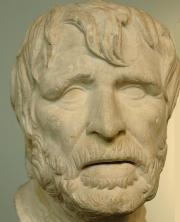
Biography
Hesiod (c. 730–650 BC) was one of the greatest poets of early ancient Greece and a near contemporary of Homer. Very little is known about his life apart from what he reveals in his own works. According to his account, his father was a merchant who eventually settled in Ascra, a village in Boeotia, where Hesiod was born and spent most of his life. He had at least one brother, Perses, with whom he became involved in a dispute over their father's inheritance.
This conflict inspired Hesiod's most famous didactic poem, 'Works and Days'. In its 828 verses, he condemns injustice, praises honest labor, and urges both his brother and the rulers of society to live according to the principles of justice and moderation. The poem also provides practical advice on farming, social conduct, marriage, and religious customs, ending with a calendar of favorable and unfavorable days for various activities. Because of its discussions of labor, wealth, and resource management, some scholars have described Hesiod as one of the earliest thinkers in economic history.
Hesiod's other major work, *Theogony*, is one of the most important sources for Greek mythology. In its 1,022 verses, he recounts the origins of the cosmos and the genealogy of the gods, describing how the universe emerged from Chaos and how the generations of divine beings—including Gaia, Uranus, the Titans, and Zeus—came into existence. The poem also preserves famous myths such as those of Prometheus and Pandora.
Unlike Homer, who focused on heroes and aristocratic society, Hesiod described the everyday world of farmers and ordinary people. His poems express concern for justice, hard work, and social order, giving modern readers a valuable glimpse into life in archaic Greece.
Ancient tradition holds that Hesiod traveled widely and achieved great fame during his lifetime. According to a famous legend, he competed against Homer in a poetry contest at Chalcis and won a bronze tripod, which he dedicated to the Muses of Mount Helicon, whom he regarded as the source of his inspiration.
Many other poems were attributed to Hesiod in antiquity, although modern scholars doubt the authenticity of several of them. He is believed to have died in the region where he was born.