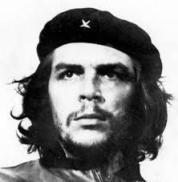
Biography
Ernesto Che Guevara (Ernesto Guevara de la Serna) was an Argentine physician, Marxist-Leninist revolutionary, one of the leaders of the rebels in Cuba. Born in Rosario Argentina, was the eldest of five children from a family of Argentine oligarchy. His parents were socializing with people of lower social classes, many of their class considered their lifestyle provocatively progressive. Ernesto was just two years old when he was found to be suffering from asthma. Growing up, instead of protecting himself, he was trying to harden and exceed it with sports. At the age of nine, he showed severe complication of asthma thus avoided the first years of school, he learned to read and write by his mother. Their home was everyday full with children from the neighborhood. From an early age was evident his sociability and his love of literature, poetry and later photography. After high school, he enrolled in the Faculty of Engineering in the University of Buenos Aires but the illness of his grandmother whom he took care of after a stroke, and his own asthma, pushed him to change subject and enroll in 1948 in medicine faculty. He completed his studies in 1953 but did not follow the clinical practice that was required in order to practice as a doctor. After graduation he traveled to Guatemala with stopovers in Bolivia, Peru, Panama, Costa Rica, Nicaragua and El Salvador. In Guatemala he met Peruvian economist Ilda Gkadea, subsequent his wife; with her help he came in contact with a wide circle of exiles and leftist intellectuals. When Colonel Carlos Armas with the assistance of the CIA attempted to overthrow the government of Arben, Guevara participated in the armed militia of the Communist youth that resisted, despite his willingness to fight at the front, he helped only as a doctor. When Arben accepted defeat and sought asylum in the Mexican embassy, Guevara who also was wanted by the new regime, sought asylum in the embassy of Argentina. Then he went to Mexico where he met Castro, agreed politically with him after long conversations and decided to participate in the movement for the armed overthrow of the Batista government in Cuba. It was decided to help as a doctor, but he took part in the military training of the rebels, showing great determination and strength. At that time he acquired the nickname Che, due to his frequent use of the word che (friend or exclamation: hey) while speaking, an expression that seemed funny to Cubans.When the guerrilla war in Cuba were launched, Ernesto changed from the task of medical support and began to take an active part in the activities of armed rebels. He showed courage, determination and leading skills in the battlefield and soon climbed the ranks of the rebel body, earning the respect of his comrades. He was the first guerrilla, who was given the rank of Comandante of the Cuban Revolutionary Army. After two years in the Sierra Maestra guerrilla war against the much larger army of Batista, who had the support of the United States, on December 29, 1958, Ernesto captured Santa Clara opening the way to Havana. On January 1, 1959, the dictator Batista fled Cuba. With the victory of the rebels, it was attributed honorary to Ernesto the Cuban citizenship and was commissioned by Fidel Castro to important positions in the new government who launched radical reforms in the country. Che Guevara became commander of the fortress La Campania, also industry minister and head of the education department of the Armed Forces, later director of the National Bank of Cuba and State Mission Representative of Cuba to the United Nations. He will develop the financial planning and the way of training of the new army of Cuba, he will play an active role in the nationalization of American companies, he will assist in the establishment of free health care system. On April 1, 1964, after a three-month international tour and a speech which caused tension in the Soviet bloc, stating that the socialist countries had to bear the cost of the national liberation struggles of countries with dictatorship, he drafted a farewell letter to Castro and left Cuba wanting to carry the revolution to the rest of the world. His differences with Castro in terms of economic and political relations of Cuba with the Soviet Union may have contributed to his decision. He went to Congo where he tried to create an armed insurgency, but without success. In February 1966 he traveled with fake passport and disguised in Prague. There he started working on the idea of a new insurgency in Latin America with an initial target of Peru, eventually he settled in Bolivia, in a mountainous region, where he was to organize the core of the guerrilla army, whose members were trained in Cuba earlier. The conflicts with the Bolivian army was scheduled but Che Guevara and the rebels failed to attract the poor Bolivian farmers and their attempts to bring revolution to Bolivia ended in failure. On 8 October, their group was surrounded and dispersed, Guevara was wounded in the right leg and his gun didn’t work. Eventually he arrested and was transferred to the nearest village La Igkera. After interrogation at the village school, Che Guevara was assassinated on October 9, 1967 by an officer of the Bolivian army who was ordered by the CIA that closely had been watching the case. The officer had initially hesitated, but finally shot the immobilized captive, whose last words were: "Shoot coward, you will only kill a man."


