Biography
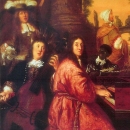
Dietrich Buxtehude (1637 - 1707) was a Danish organist and composer, one of the most important composers of works for the ecclesiastical instrument before Bach.
He was probably born in 1637 in Helsingborg, Scania, then owned by Denmark (now part of Sweden). His father was the organist at St. Olaf Church in Helsing, he was his first teacher. Dietrich followed in his father's footsteps and worked as an organist, first in Helsingborg (1657-1658), then in Helsingor (1660-1668) and finally, after 1668, in Lübeck's Marienkirche. There he succeeded Franz Thunder, whose daughter he married in 1668. They had seven daughters, the first of whom died an infant. His position in the free imperial city of Lübeck offered him considerable freedom in his music career. In 1673 he reorganized and enriched a series of evening musical performances, managing to attract musicians from various places; those performances became an important musical event of the church and the city until 1810. In 1703, Handel and Mattheson both traveled to meet him while 2 years later, the then young Bach stayed in the city for 3 months to meet and hear the famous organist player.
The main volume of Buxhehude's compositions consists of vocal music with a wide variety of styles, as well as organic works. More than 100 of his vocal compositions have been rescued. Chamber music is a small part of the surviving production, although the only chamber works published during his lifetime were fourteen chamber sonatas. His surviving church music is praised for its high musical value but not for its progressive elements.
Buxhehude died on May 9, 1707. Historically, he is one of the most important composers of the Middle Baroque period and as a composer who worked on various vocal and organ idioms, he influenced many other composers, most notably Bach.


