Biography
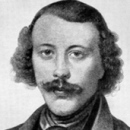
Mikhail Alexandrovich Bakunin (May 30, 1814 – July 1, 1876) was a Russian anarchist theorist and one of the best-known revolutionaries of the nineteenth century. He opposed every form of state authority, including the socialist state. He was born in the village of Priamukhino, in present-day Tver Oblast, Russia. As the son of an aristocratic landowner, he was expected to pursue a military career and entered the Artillery Academy of St. Petersburg. In 1832 he became an officer, but feeling constrained by military life, he soon resigned and moved to Moscow to study philosophy.
Bakunin learned German in order to read Hegel in the original language and even translated one of his works into Russian. In 1842 he moved to Berlin, where he came into contact with the Young Hegelian movement. During this period he began writing revolutionary manifestos. He later traveled through Belgium and Switzerland and, in 1848, arrived in Paris. There he took part in the revolutionary uprisings of 1848, earning the respect of workers at the barricades as the rebellious aristocrat who embodied the anarchist ideal.
In Paris he met Proudhon and Marx and gradually developed the principles of the social revolution he envisioned. During this period he wrote "The Appeal to the Slavs," in which he denounced the bourgeoisie as corrupt and called upon workers and peasants to become the driving force of revolution.
During the Dresden Uprising of 1849, Bakunin once again fought at the barricades. He was arrested and imprisoned in Austria until May 1851, when he was extradited to Russia. There he spent another six years in prison, condemned for his revolutionary activities and writings. The harsh conditions severely damaged his health.
In 1861 he escaped from Siberian exile, boarded an American ship bound for Japan, and eventually returned to England. There he reconnected with Russian revolutionaries and published "The Revolutionary Catechism," further clarifying his anarchist ideas.
In 1868, while based in Geneva, he joined the First International, a federation of working-class organizations. He soon came into conflict with Marx, and in 1872 Marx succeeded in having Bakunin and his followers expelled from the organization. With the publication of "Statism and Anarchy" the following year, Bakunin's anarchist philosophy reached its final form in direct opposition to Marxist communism.
Bakunin spent his final years in poverty, having exhausted much of his fortune in support of revolutionary causes. Nevertheless, he continued writing, organizing, and calling for social revolution until his death on July 1, 1876, in a hospital in Bern, Switzerland.