
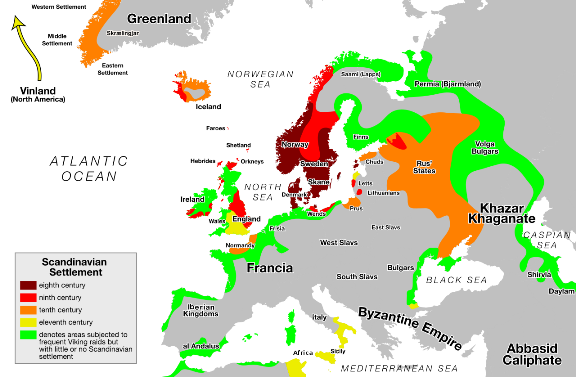
The Norwegians
Until The 8th century Norway was segregated into small local kingdoms or communities; in the end of the century some of those collaborated for pirate or exploring missions, with impressive results. In Ireland they established fortified ports including at Dublin, from which they dominated much of the eastern part of the island. In Scotland they established an earldom in the Orkneys and overran the Shetlands and the Hebrides. They arrived in England in 865 and they picked off the Anglo-Saxon kingdoms of England one by one: Northumbria, East Anglia, the central English kingdom of Mercia. The Norwegian Vikings while sailing west made the first known journeys to Island(874), Greenland(984) and around 1000 they reached Canada. Because they found many wild vineyards, they named the unknown country Vinland (the land of wine). They made a colony there but abandoned it shortly afterwards. In 1066, king Harald the terrible, tried to conquer England but he was killed and the gold era of the Norwegians Vikings ended.The Normans
In France they grew in strength as a divided Frankish kingdom fractured politically and in 885 a Viking army besieged and almost captured Paris. The Francs named them Normans which means people from the north, and offered them land and independency in exchange their submission to the throne. They agreed and in 911 the first Norman Nation was created. Later the Normans will expand and rule England.The Swedish
In the 10th century the Swedish Viking had already been gathered into a nation and with allies the Danish they annihilated the Norwegian fleet in 999 making Sweden the most powerful Viking nation. It did not last for long as the country was fractured into the supporters of the new religion (Christianity) and the pagans. In 1066 a problem occurred with the succession and a civil war followed with the victory of the Christians and the introduction of absolute monarchy.The Varangians,
The Varangians moved towards the east and came in contact with Byzantium. They formed the Byzantine Varangian Guard and between the 9th and 11th centuries settled among many territories of modern Belarus, Russia and Ukraine and they ruled the medieval state of Kievan Rus. Beginning in the 8th century, the Danes initiated the construction of trading towns across their realm, including Hedeby, Ribe, Aarhus and Viborg and expanded existing settlements such as Odense and Aalborg. Hedeby quickly grew to become the largest settlement in Scandinavia and remained so until its eventual destruction in the later half of the 11th century.The Danes
The Danes began a long era of well-organised raids from around 800 across the coasts and rivers of Europe, many of which were followed by a gradual succession of Danish settlers, including the Danelaw in England and countryside and newly established towns in Ireland, the Netherlands and northern France. In the early 11th century, King Cnut the Great (died 1035) ruled the extensive North Sea Empire. During the 10th century the royal seat of the Danes was moved from Lejre to Jelling in central Jutland, marking the foundation and consolidation of the Kingdom of Denmark.
Vikings warriors

Christianity came later to Scandinavian Viking societies than to many other parts of Europe. Whereas France’s kings had accepted Christianity by the early sixth century and the Anglo-Saxon kings of England largely in the seventh, Christian missionaries only appeared in southern Scandinavia in the ninth century. At first, the Viking loved their own Gods, even when a Danish or Swedish king became Christian and proclaimed his people were Christian, many still practiced their pagan ways and held to the old gods. By the end of the Viking Age, however, most Vikings had become fully Christian and were baptized and buried in that faith.
Four modern nations derive from the Vikings: Norway, Sweden, Denmark, Iceland and 6 played a major role in their creation: Great Brittan, France, Finland, Russia and Ukraine. Back to the Story of Humankind