German tribes were settled on the border of the Roman Empire from the 1st century, the Romans were called them "barbarians," as the Greeks called all non-Greeks, by the incomprehensible sounds of their languages that sounded like "bar bar bar". The barbarians formed their own society and they were good craftsmen in contact with the Romans with whom they commerce. In the 3rd century, they exploited the chaos of the Roman administration and begun to invade lands of the empire on a small scale; they were making sporadic raids and returned with the prey to their lands. After 376 the agitation caused by Hun’s raids and because of Slavic pressure, as well as conflicts between different tribes, pushed the German people into attacking and mass moving into the lands of the Roman Empire.
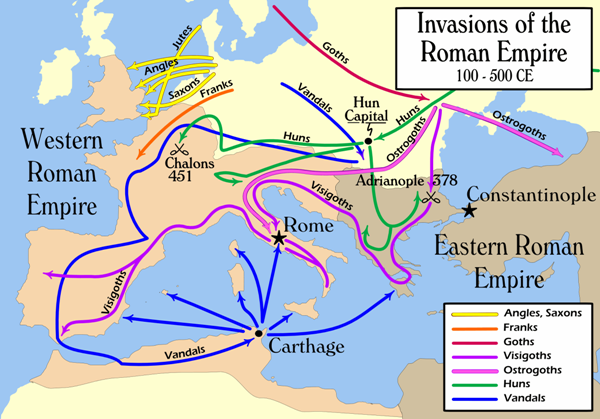
The first to enter Roman territory were the Visigoths in 376 as refugees from the Huns. They invaded Italy, looted Rome in 410 CE, before settling in Iberia where they founded a kingdom that endured 300 years. Next invaders were the Ostrogoths who settled in Italy. In Gaul, the Franks, a fusion of western Germanic tribes whose leaders had been strongly aligned with Rome, entered Roman lands more gradually and in some areas peacefully during the 5th century; they were generally accepted as rulers by the Roman-Gaulish population. Fending off challenges from the Allemanni, Burgundians and Visigoths, the Frankish kingdom became the base of the future states of France and Germany. Meanwhile, Roman Britain was slowly invaded and settled by Angles and Saxons and the highly aggressive tribe of Suebi defeated the Castilians and founded their own kingdom in northern Portugal (Lusitania); it was annexed in 585 by the Visigoths and was turned into a province of the Visigothic Kingdom in Iberia.

Between 500 and 700, Slavic tribes settled in Central and Eastern Europe and gradually making it predominantly Slavic. The Bulgars, possibly of Turkic origin who had been present in far Eastern Europe since the 2nd century conquered the eastern Balkan territory of the Byzantine Empire in the 7th century. The Lombards, a Germanic tribe, settled in the region of Lombardy (as it now known) in northern Italy. Migrations of peoples continued beyond 1000, marked by Viking, Magyar, Turkic and Mongol invasions, having also significant effects, especially in Central and Eastern Europe. Back to the Story of Humankind