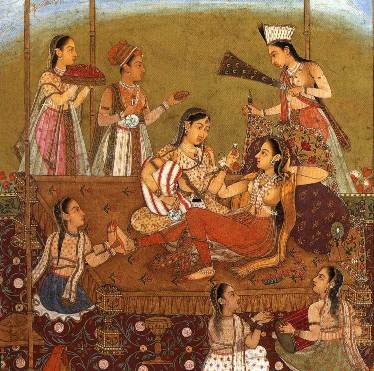
In 320, Chandragupta I succeeded in uniting the Indian kingdoms into a single state and so it began a long period of peace and prosperity for India under the Gupta dynasty. His son will further extend the Empire to bring it to its peak in 360, bestowing to the people a generalized sense of security, personal freedom, religious tolerance and social order.
Gupta developed a welfare state with Pataliputra (today Patna), where, among other things, there were hospitals where the poor could be hospitalized for free. The king's power was limited by the sacred laws, there were courts in which justice was given, and the women had several freedoms, although the practice of sati appeared, the burning of women with the corpse of their husband when he was dead.
The Gupta period (320-550) is called the Golden Age of India, as it has been a great scientific and artistic advance and extensive discoveries occured in Science, Technology, Art, Astronomy, Religion, Philosophy, Crystallizing Hindu Culture and Brahmin Religion.
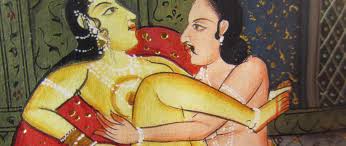
Under the Gupta dynasty, agriculture and trade flourished, exquisite palaces and temples were built, great literary works were written. At that time the ancient Sanskrit Hindu epic "Mahabharata" reached its final form and Kama Sutra was written.
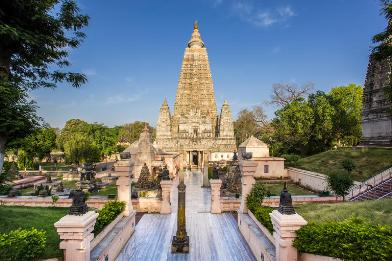
The great poet of India Calinda (has been called Sanskrit Shakespeare), created immortal epics and dramas. In architecture, one of the largest monuments is the famous Mahabodhi Temple, where the Buddha is said to have achieved enlightenment, while the mysterious 7-meter iron pillar in Delhi - which to date does not show signs of rust - is a remarkable metallurgical achievement. Astronomy has proven - among other things - that the Earth revolves around the Sun and its own axis, while the astronomical and mathematical treatise called Surya Siddhanta contains a definition of sinusoidal function used in trigonometry. It may be attributed to the Arabs because they communicated it to the Europeans, but they were the mathematicians of India who devised the decimal numerical system and the notion of zero. In addition, they used the number π, the negative numbers and the second degree equations.
MAHABODHI
At 550 after successive Huns invasions from central Asia, the central administration collapsed and the country was broken down into hundreds of small kingdoms. Thατ was the end of India’s Golden Age and the Gupta Empire as well.
Back to the Story of Humankind