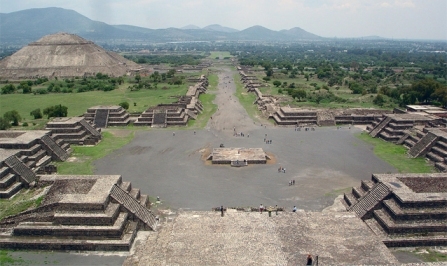
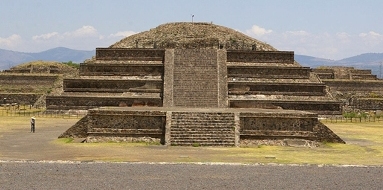
In the Valley of Teotihuacan, about 40 kilometers northeast of today’s Mexico City, scattered villages and communities had been established since 600 B.C., which gradually joined and formed Teotihuacan; a city-state which would evolve into a huge urban and administrative center with cultural influences across the wider region. The city was formed on a central axis of "The Avenue of the Dead," which started from the Moon's Pyramid, passed in front of the Colossal Pyramid of the Sun and ended in the Temple of Feathered Serpent, the mysterious 6-level pyramid dedicated to the God of Heaven and the creator of natural laws.
View of the Avenue of the Dead and the Pyramid of the Sun, from the Pyramid of the Moon.
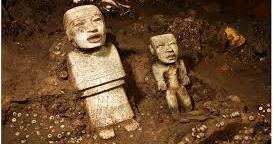
Below the Feathered Snakes Temple was discovered a 103-meter underground passage which crosses underneath the Avenue of the Dead and ends at the opposite side of an altar or tomb. So far, about 50,000 objects (statuettes, jewelery, shells, etc.) have been found, 1800 years old. The objects are related to some sort of ceremony; exploration of the tunnel continues, it may take some more time for the researchers to reach it to the end.
Temple of the Feathered Serpent
The name of Teotihuacan, which means "the city of gods" or "the city where people become gods", was given by the Aztecs who inhabited the area in the 14th century. As the meaning of the word suggests, Teotihuacan was a theocratic state where the priesthood exercised supreme power. For sure, there were human sacrifices with which -they believed- the gods were exalted and the city was drawing its military power.
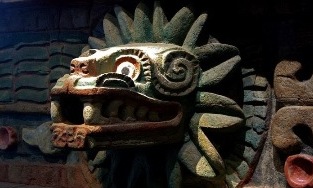
During the period from 0 to 300 the city evolved in a metropolitan area of the wider region. This period is remarkable for its monumental architecture and sculpture. The period from 300 to 650 was called the Classic Period; Teotihuacan reached the peak of its power and glory. Its population was estimated at 200,000 inhabitants and the city was one of the largest in the ancient world, with 2,000 buildings and an area of 30 square kilometers. There was massive reconstruction of monuments and the temple of the feathered snake was covered at that time with rich sculptural decoration. Typical artwork of this period was the "funeral masks", crafted mainly by green stone and covered with turquoise, shell or obsidian. They attribute the human face to natural size and were intended to cover the face of the dead at the time of burial.
Since 650 began the decline of the city that lasted for about a century. In 750 the weakened city was destroyed by the Toltec, who invaded the area. Temples, palaces and dwellings were transformed into ruins, the population was slaughtered. After several centuries, the Aztecs civilization would flourish in the same area.
Back to the Story of Humankind