A group of small, nocturnal, tree-dwelling, and insect-eating mammals known as the Euarchonta evolved into the ancestors — among others — of the primates. One of the earliest primate-like mammals was Plesiadapis.
 The main biological characteristics of primates developed as adaptations to forest environments and life in the trees. Two traits that played a crucial role in their success within this arboreal and insectivorous environment were grasping fingers and toes — with the first digit opposable to the others and equipped with nails rather than claws — as well as binocular vision.
Although early primates were mainly insectivorous, later adaptations in their teeth allowed some groups to become herbivorous or omnivorous. Plesiadapis developed features that enabled it to survive on the ground as well; for this reason, it fed on fruits and leaves from low branches. Today, plesiadapiforms are considered close relatives or possible ancestors of the earliest true primates.
About 55 million years ago, early primates split into two major groups: the prosimians (“before the monkeys”) and the higher primates.
PROSIMIANS
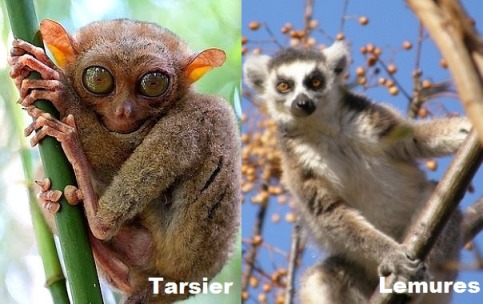
Prosimians resembled a combination of a cat and a squirrel and are mainly represented by two groups: tarsiers and lemurs, which evolved primarily in Madagascar. They were mostly insectivorous or omnivorous animals with highly developed vision, since most of them were nocturnal, while many possessed long tails that helped them maintain balance in the trees.Tarsiers have exceptionally large eyes relative to the size of their bodies and brains, while their heads can rotate approximately 180 degrees. Lemurs are endemic animals of Madagascar. Their name comes from the Latin word lemures, meaning “spirits of the night,” because of their bright and glowing eyes.
HIGHER PRIMATES
This group includes monkeys, apes, and humans. Higher primates evolved into diurnal mammals that fed mainly on leaves and fruits. At the same time, their brains increased significantly in size, and a more developed cerebral cortex emerged, responsible for coordinating more advanced senses and behaviors.The face became shorter and broader, the forearm gained greater mobility so that the hand could rotate more freely, and the opposable thumb appeared. The forelimbs and hindlimbs became differentiated both in structure and function. Vision evolved into binocular stereoscopic vision, allowing accurate perception of distance.
The evolution of higher primates produced an impressive variety of adaptations, ultimately leading to the emergence of apes and humans. Back to the Story of Humankind