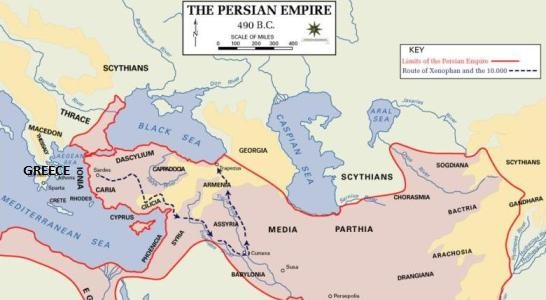
In 547 BC, Cyrus the Great had conquered the Ionic cities and had put tyrants as commanders, forcing the natives to pay taxes, to give men for the Persian army and to set the commerce for the benefit of Persia. The natives retaliated at 499 BC. The Greek army with contribution from Athens and Eretria conquered and burned the local capital of Sardis. The Persian king, Darios promised revenge and after a series of conflicts, at 494 BC, he attacked Militos, the centre of the rebellion. In a naval battle the natives were defeated and the rebellion ended. Trying to ensure the protection of the empire from other rebellions and the interference of the mainland Greece Darios decided the capture the whole the Greece and to punish Athens and Eretria as well for the destruction of Sardis.

The first Persian invasion began in 492 BC with the Persian commander Mardonios to conquer Thrace and Macedonia. He stopped the invasion after a series of misfortunes. In 490 BC a second attempt was made, this time through the Aegean Sea. The Persians invaded Cyclades and managed to destroy Eretria. But in the way for Athens they were defeated from Athenians in the battle of Marathon and they had to stop their attempts. The battle of Marathon had a huge meaning for the Greeks; it toned up their moral, tumbled the myth that the Persians were unbeatable and amplified the willing of the other Greek cities to resist the Persian attack. After ten years, Xerxes A, the Persian emperor, lead the second Persian attack to Greece, with the biggest ancient army the world had ever seen. The win of Persians at Thermopiles allowed them to take a substantional piece of Greece, although they had many casualties. This fact played a major role in the following events. The Greek destroyed the Persian fleet at the naval battle of Salamis and the next year they counterattacked them, wining in 479 BC the battle of Plataea and dismissing them from Greece. After this battle, no other Persian emperor even tried to invade Greece again and Europe was saved from Persian expansion. The Greeks passed to counterattacks and won many battles in Asia Minor; later Alexander the Great will conquered the whole of Persian empire. Back to the Story of Humankind