Seleucus declared Antioch as the capital of his empire (by his father’s name Antiohus) and kept the Persian administration organization with the territory to remain divided into 25 satraps whose administration assumed Greek officials. The Seleucids attempted to strengthen the Greek element, mainly by setting up new cities to which they granted relative autonomy. In addition to the capital of Antioch in northern Syria, other important administrative centers were the Sardis in Lydia and Seleuceia on the Tigris River.
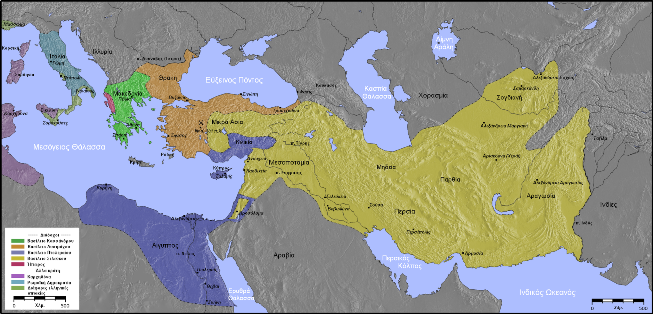
Official language remained Greek, as it had been established since the time of Alexander the Great, in the highest state offices was appointed Macedonians who constituted the ruling class. At the same time, they treated the other peoples who lived in the kingdom with tolerance, they respected their languages and their religions. In remote parts of the state, which they had difficulty retaining under their control, they gradually granted rights to some local rulers, according to what the satraps had in the oldest Persian Empire. Even so they were unable to effectively control the distant regions and the Empire had fluctuations in its size. Because of the separatist tendencies and the conflicts with the Ptolemies and the Romans, the Empire began to decline and the -247 came under the control of Parthia, a small kingdom in northeastern Persia. The Parthians were experienced warriors and wretched riders, known for their ability to throw their bow backwards while riding. The Seleucids lost power and gradually assimilated into the Empire of the Parthians, who adopted a mixture of Greek and Persian civilization.
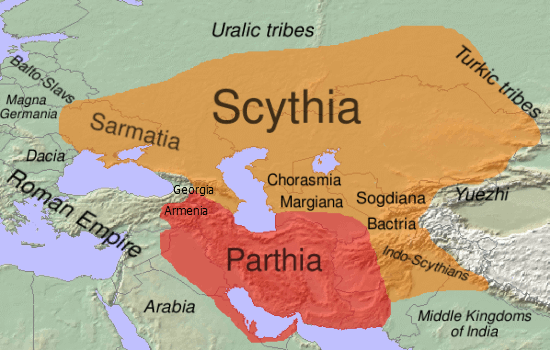
When they extended to the west, the Parthians clashed with Rome to control Armenia, later the Romans wanted to extend to the east and their greatest defeat in the battle of Carres. Many conflicts followed, and sometimes the Romans reached up to the capital Ctesefonda but the Parthians always managed to resist and drive them away. Eventually the Parthians collapsed not because of the Romans but because of internal turmoil. A series of Parthian rulers' conflicts of power weakened the state so in 247 AD the rising Sassanid dynasty occupied the country and took over. Back to the Story of Humankind