The Expansion of Humanity Across the Continents Around 100,000 years ago, the ancestors of modern humans had already spread across large regions of Africa and began their great expansion into Eurasia. Probably through the Red Sea region or the Sinai Peninsula, they crossed into the Arabian Peninsula and from there gradually spread toward India and deep into Asia.
Around 74,000 years ago, one of the greatest volcanic eruptions in Earth’s history took place: the eruption of Mount Toba in present-day Indonesia. Vast quantities of volcanic ash covered large parts of Asia, while the global climate experienced a dramatic cooling that lasted for many years. Many scientists believe that during this period the human population declined drastically and that our species passed through one of the most dangerous moments in its history.
Thousands of years followed in which colder and warmer climatic periods alternated. When the climate became milder, groups of humans moved farther north toward Central Asia and the region of the Caspian Sea. Around 45,000–40,000 years ago, Homo sapiens spread into Europe through the Eastern Mediterranean, the Aegean, and the Balkans.
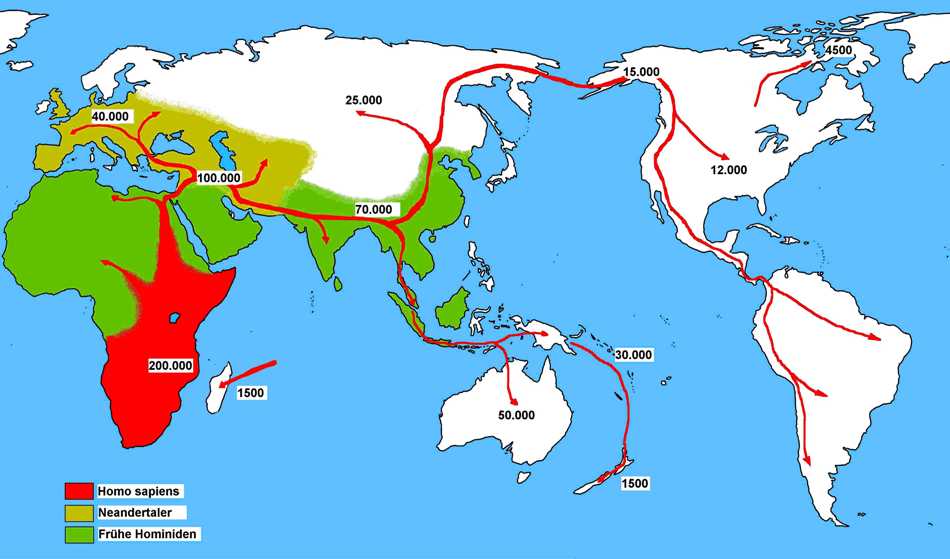 Around 25,000 years ago, humans had settled across large parts of Central and Northern Asia. During the last Ice Age, when sea levels were far lower than today, a vast land bridge connected Siberia and Alaska: Beringia. Through this passage, around 20,000–15,000 years ago, groups of humans crossed into the Americas for the first time.
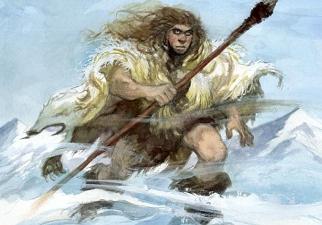
The journey through the frozen lands was extremely difficult. Yet humans had already learned how to make warm clothing from animal skins and furs, use fire, and survive in extremely cold environments. They most likely followed large herds of mammoths, bison, and other animals that provided them with meat, fat, bones, and hides.
 From Alaska, the first humans gradually spread southward and within a few thousand years reached the southernmost tip of the Americas. During this expansion, enormous ecological changes took place. Many large animals of the Americas — mammoths, mastodons, giant ground sloths, saber-toothed cats, and many other species — disappeared. Scientists believe that both climate change and intensive human hunting contributed to their extinction.
For thousands of years, the Americas had been an isolated world filled with unique plants and animals that had evolved differently from those of Eurasia and Africa. After the arrival of humans, many of these species vanished forever, leaving behind only fossils and traces of a lost world.
From Alaska, the first humans gradually spread southward and within a few thousand years reached the southernmost tip of the Americas. During this expansion, enormous ecological changes took place. Many large animals of the Americas — mammoths, mastodons, giant ground sloths, saber-toothed cats, and many other species — disappeared. Scientists believe that both climate change and intensive human hunting contributed to their extinction.
For thousands of years, the Americas had been an isolated world filled with unique plants and animals that had evolved differently from those of Eurasia and Africa. After the arrival of humans, many of these species vanished forever, leaving behind only fossils and traces of a lost world.
The spread of humanity across all continents was one of the greatest journeys in the history of life — but at the same time it marked the beginning of humanity’s profound and often destructive impact on the ecosystems of the planet. Back to the Story of Humankind