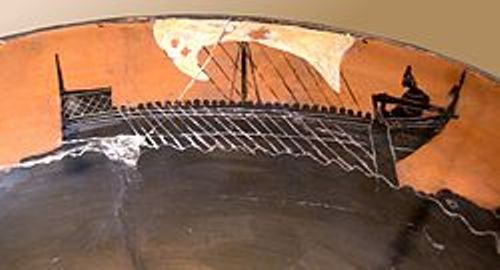
GREEK SHIP ON ANCIENT POTTERY
Aeolians settled in the lands near Troy and founded the 12 cities of the Aeolian Union, Mycenaeans from the Peloponnese went to the Cyclades and Asia Minor, establishing the 12 cities of the Ionian Union, Dorians descended to Crete and Rhodes. In Asia Minor there were also Greeks who survived the Trojan War, had returned to their homelands and found things changed to the worst so they returned to Troy and made a fresh start.
The Greeks used to take a little soil from their homeland and a torch with fire from their home which they were passing it to their new homeland. The places they chose were close to the coast so that they always have ships near them, for safety reason in case of danger. Good locations were often occupied so they often have to fight for them. In those cases, they killed or turned the previous inhabitants into slaves, in other cases they gave presents and managed to charm the natives with their higher cultivation so they would overcome them in a peaceful way. The colonies maintained a loose coalition with the Metropolis; they had the same language, the same gods, similar social and political organization, close trade and cultural relations, and the Olympic Games to unite them every four years into a single set.
GREEK COLONIES AND MAIN TRADE ROUTES
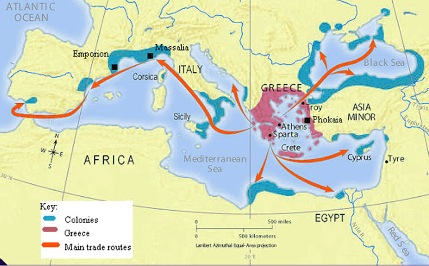
During the second Greek colonization, Greeks left for Hellespontos, Propontis, and Pontus, while other groups headed for Italy, Sicily and then in second time to Galatia and Spain, dominating the entire Mediterranean coastal zone. In Sicily there were so many Greek cities that the island acquired the name Greater Greece.
Colonization was a blessing in many ways as it gave way to the overwhelming population of Greece’s mainland, created new markets and gradually a Greek merchant empire that laid the foundations for the development of the unsurpassed Greek civilization. Back to the Story of Humankind
During the second Greek colonization, Greeks left for Hellespontos, Propontis, and Pontus, while other groups headed for Italy, Sicily and then in second time to Galatia and Spain, dominating the entire Mediterranean coastal zone. In Sicily there were so many Greek cities that the island acquired the name Greater Greece.
Colonization was a blessing in many ways as it gave way to the overwhelming population of Greece’s mainland, created new markets and gradually a Greek merchant empire that laid the foundations for the development of the unsurpassed Greek civilization. Back to the Story of Humankind